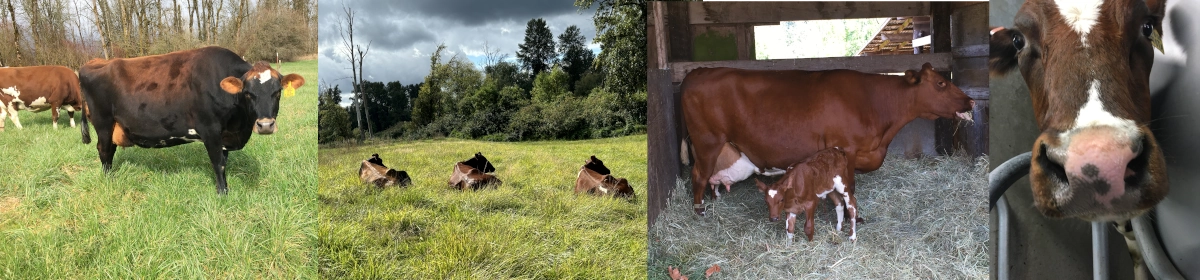
Keith’s ‘Ladies’
Before we started the Creamery, Keith was milking a herd of about 70 Holstein cows. All the milk was sent to a dairy Co-op that he belonged to. As the Creamery grew he started crossbreeding them to Guernsey, Jersey, Swedish Red, Normandy and Wagyu. He did this to bring up the butter fat in the milk and also the cross breeding can bring the best of both breeds forward. It takes years of experimenting with crossbreeding to find the perfect match, which may never show itself. After all, no one is perfect. Not even the animals. Now, all the milk the cows produce goes to the creamery and the heard is only about 14 dairy cows.
Keith’s cows go out to graze all summer and fall, and as often as weather permits in winter and spring. Cows can have a big impact on wet pastures. Healthy pastures are the key to healthy animals, so overgrazing or letting animals damage the pastures in wet weather, is detrimental to the animals.
Milking happens twice a day, at around 6 am and again around 3:30 pm, every day of the year. The animals are used to this schedule. They gather in front of the milking parlor at these times, although in the summer time, when the weather is perfect, the cows sometimes have to be brought in from the field. Lounging around in the field is so lovely that they need to be nudged to get milked. After they are done, they go back out to the pasture and spend the nights out in the open. They love that.
Cows love routine. Every day is the same for them and they love it. They start gathering at the milking parlor at around 5:30 am. Milking is finished around 7. Then the calves are fed and the milking parlor cleaned. The cows are then fed hey. They always have access to very high quality hay, even in the summer when they spend most of their time out on pasture. At times they prefer to eat hay in the cool of the barn. During the summer they have access to the barn for shade. On hot afternoons they often prefer to lay in the cool of their sand filled stalls instead of out on pasture. They have the choice. In the wintertime they roam around the barn areas. Each one has a private stall in which she can lie down and chew her cud. Content cows like to lie down and chew their cud a lot. It is important for their health to have a quiet place to do so.
A 1100 pound dairy cow needs about 30,000 calories a day to stay in good condition. The feed she gets has to be a very high quality. Each bite needs to be filled with nutrition, so the timing of haying is very important. A few days of delay in haying can affect the quality of the hay. From mid-May until the beginning of September haying is on Keith’s mind. All the hay comes from the Fagernes Farm. Howard, Keith’s brother often helps him with haying as it can be a challenge for one person to get all the haying done, milk the cows and do all the other every day chores during haying season.
The Life Of Our Dairy Cows
The calves are born in the maternity pen. This is an enclosed area in the barn, where the cows can give birth in a quiet setting, and Keith can help them if necessary. Most births are normal, but there are times when a calf has to be pulled, or when it comer out backwards, or with the placenta wrapped around it’s nose. Keith is on call for those kind of issues 24/7. Just as with human babies, not all are born during daylight hours. There are many sleepless nights in the life of a dairy farmer.
After the calves are born and their moms clean them off. They need to get the colostrum from their mother’s utter ASAP. If they do not figure that out within a couple of hours, Keith intervenes and feeds them colostrum with a bottle. Calves are born without any immunity, they get all of that from their mother’s first milk (colostrum). It is therefor absolutely vital that they get that colostrum soon after birth. They are bottle fed for the first few days, and as they get a little older they drink milk out of a bucket. After about one week in the rearing barn, they are moved into the calf barn. There they hang out with other calves and have access to on outside area to hop around in. This is where they get vaccinated and castrated if needed. When the calves are about three months old, they move to an open pasture and get to hang out with lots of calves of various ages. This is like a kindergarten, a place where a lot of playing happens. They can run around the pasture, but also have a barn for shelter and food. All the calves that are not meant as replacement dairy cows get harvested for meat. See our other farm webpage Bone Dry Ridge Farm. They are Wagyu crosses and are of an exceptional meat quality.
When a heifer (a cow before she has her first calf) is old enough to be bred, she moves to the heifer barn. This is right next to the kindergarten, so it is just a matter of opening a gate. The heifer barn is more then just a barn. It has a series of pastures around it for all the heifers and the beef animal to graze. These pastures are grazed in a rotational pattern. After the heifer is bred by Artificial Insemination (AI) by Keith, she gets to hang out in the heifer barn/pasture area until she is about a month away from giving birth. She then is moved into the milking herd, so she can get used to the routine of being a dairy cow, and because she needs to find her place in the milking herd. There is a hierarchy within the herd and each cow finds her place. What determines her status within the herd is a bit of a mystery to us. Almost all of their communication is body language and we humans can only interpret a small fraction of their language.
The heifer goes through the milking parlor like the other cows. This is a very strange experience in the beginning, but as the days go by she is more and more comfortable. When she gives birth to her calf and starts being milked she is ready. About three months after she freshens (starts being milked) she is bred again, and about 2 months before she gives birth again she is dried off (not milked any more) and given a break until the whole cycle starts over again.