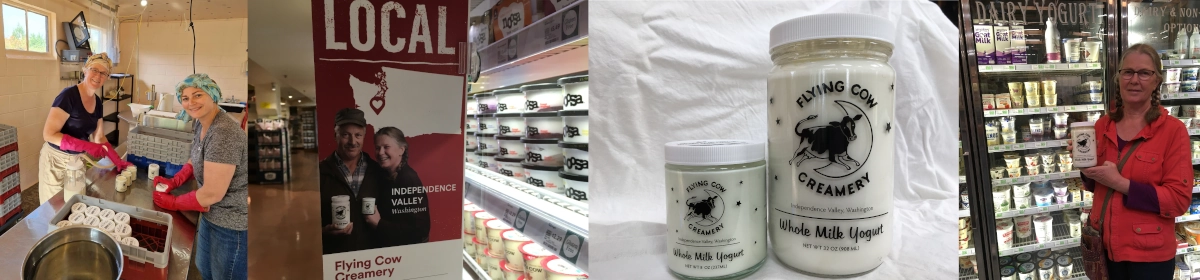
Our Yogurt:
We make yogurt the old fashioned way, using only milk and yogurt culture. We prefer to use a culture that includes not just basic yogurt cultures like Streptococcus thermophilus and Lactobacillus delbrueckii subsp. bulgaricus, but also pro biotic cultures like Lactobacillus acidophilus and Bifidobacterium lactis. We never even considered using thickeners. A perfect product is a perfect product. You will be surprised at how many yogurts on the market have thickeners. Read the labels. Real yogurt is made using only fluid milk and culture. Nothing else is needed. There are many varieties of yogurt cultures available, and what makes one yogurt different from another is the combination of yogurt culture and the milk that is used. The milk reflects the terroir (flavor indicative of the soil where the grasses grow, where the cows graze). Therefore each farm can have a different kind of yogurt.
Yogurt is pasteurized. One can make cultured milk at many different temperatures but yogurt is made by heating the milk to 180 F then cooling it down to just above body temperature, adding culture. Then we keep it warm for 18hours during which time the yogurt culture bacteria eats the milk sugars and turns them into lactic acid.
Our Yogurt Flavor:
We experimented with many different yogurt cultures. Our community members here in Independence Valley were our testing grounds. Every week Selma would make a batch of yogurt and bring it to the neighbors, who in turn filled out survey forms and voted on the yogurt quality, taste and texture. After trying many cultures and culture combinations, the Independence Valley community voted the one we use, as the winner.
Seasonal Variation:
Yogurt is a live product, derived from live milk. That in turn reflects what the cows are eating. They do not eat the same thing all year round. In the summer they consume mostly the green grass right off the fields and in winter, mostly hay and silage. They are offered organic grain as a treat in the milking parlor. Therefore there is and will be some seasonal variation in our products.
The Glass Containers:
We felt very strongly about using glass containers. Yogurt is incubated in the container. Warm milk, with yogurt cultures, is poured into the containers and then kept warm overnight, and then cooled down. There was no way we were going to do that using plastic containers, not with the knowledge we have today about chemical leaching from plastic into our food. We also felt very strongly about using American made glass containers. This proved more complicated then one would think. Selma researched glass containers off and on for many months. There no longer is very much glass manufactured in America. It seems the majority of the glass used in this country comes from China. Glass containers made in China are three times less expensive than American made containers, but we felt that if we (producers of American made products) did not support American industry, who would.
The American made glass selection was not huge when we started the creamery on 2013. Over the years it has dwindled down to, as of 2022, there is no one in America making our glass containers. Then we started buying glass from Germany. We figured that they at lest have good labor standards and good wages. But now with high tariffs on products from Europe posed by our government, the company that we were dealing with has put a minimum orders of 200,000 jars at a time. We only buy about 5000 jars per years since our jars are on a deposit and we get 75% of them back and reuse them over and over again. We therefor had to find somewhere else to buy jars from. That place was India. It seems insane to us that since 2013 manufacturing of glass has changed that much in our country that now we have to get containers from halve way across the world. But things are in endless motion of change. Every time we need to buy more jars we ask the middle man to look for anyone in America making these jars. As of February 2026 there is no one.
In 2024 we received a grant from Washington State Department of Agriculture to silk screen our own jars. We had been using BJ Silkscreen for years. They were a very nice business to deal with but in 2024 they moved from Auburn to Blaine Washington. That was very inconvenient for us, 6 hour drive one way. BJ Silkscreen sold us one of their old silk screen machines and tought us how to use it and then the only thing we needed was a flamer (the jars need to be flamed before they are silk screened to burn off a thin layer or wax) and an inc curing machine. We asked WA Dept. of Agriculture for help and they gave us a grant to acquire these things and as of January 2025 we are silk screening our own jars. This was not an easy process to learn, but we preservered and eventually were able to print out decent looking jars.